
REVIEW · OLIVE OIL TOURS
Tirana Walking Tour, Extra Virgin Olive Oil and Raki Tasting
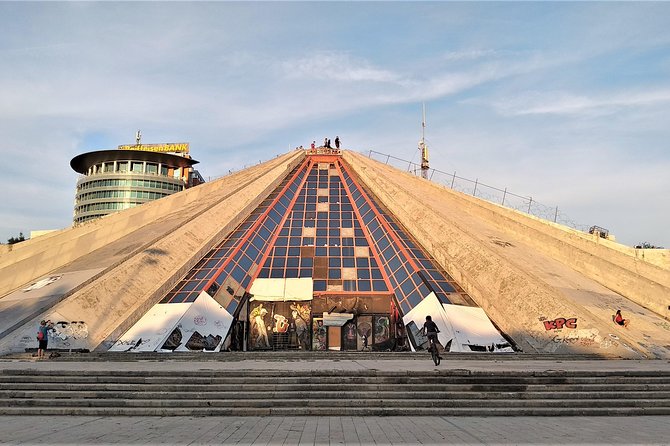
Tirana’s story makes the most sense on foot, and this tour connects its Ottoman, communist, and modern chapters in a compact 2 to 3 hours. You move from Skanderbeg Square to the castle, Blloku, and the Pyramid of Enver Hoxha, then sample extra-virgin olive oil and fruit raki.
I like the local focus, especially the chance to ask about restaurants, shops, and Albanian customs as you walk. I also like the price: at $22.69 per person, it offers a useful first look at central Tirana without taking up half a day.
The main caution is operational rather than cultural. One booking went badly wrong after a date change was not recorded, leaving the customer waiting without contact. The provider refunded the booking and apologized, but it is sensible to check your confirmation and meeting time before setting out.
Key points at a glance
- Taste Albanian olive oil and several fruit rakis, including versions made from blackberries and plums.
- Start at Skanderbeg Square, the city’s main civic space and a useful place to understand Tirana’s changing political story.
- Walk through Tirana Castle and Murat Toptani Street, a central route lined with historic and cultural sights.
- See Blloku and the Pyramid of Enver Hoxha, two places that explain Albania’s shift from communist rule to modern city life.
- Expect a guide-led walk rather than a formal museum tour, with room for questions and local recommendations.
- Plan for an easy but exposed city walk, since the tour requires good weather and includes several outdoor stops.
Why this short Tirana tour works
Tirana can feel confusing at first. Its broad central avenues, Ottoman remnants, Italian-designed buildings, communist monuments, cafés, and new commercial spaces do not always explain themselves. A local guide gives you the connections.
This walk is useful because it does not treat the city as a collection of unrelated photo stops. Skanderbeg Square introduces the national story. The castle and Murat Toptani route bring you into older Tirana. Blloku explains the city’s political divide and its post-communist change. The Pyramid shows how Albania is still deciding what to do with its recent past.
The guide is an important part of the experience. Taulant is named in several highly positive accounts, and his style seems to include history, practical advice, and personal recommendations. You might receive a different certified guide, but the strongest part of this format is the chance to ask questions as the city passes around you.
This is not a long historical lecture. The listed stops are brief, usually around 15 to 20 minutes, with the rest of the time spent walking and talking. That makes it a good first activity in Tirana, especially if you want orientation before exploring on your own.
More Raki and Ouzo Tastings in the world:
- Crete: Full-Day Cretan Wines, Olive Oil, Raki and Food Tour
★ 5.0 · 264 reviews - Crete: Olive Oil, Soap, Wine, Raki – Flavorful Culinary Journey
★ 5.0 · 119 reviews - Crete: Olive, Wine, & Raki on a Flavorful Culinary Journey
★ 4.7 · 56 reviews
Skanderbeg Square and the city’s changing center
The meeting point is the equestrian statue of Skanderbeg in Skanderbeg Square. This is a practical place to begin because the square is central, open, and easy to identify.
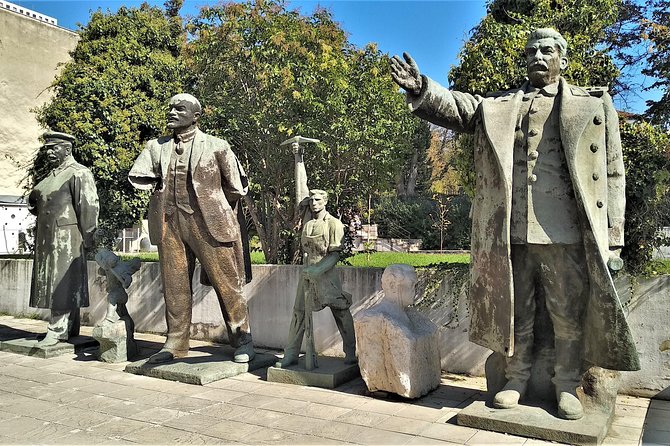
The square was conceived before the Second World War by Italian architect Armando Brasini. Its appearance and symbolism changed repeatedly as Albania passed through monarchy, Italian influence, communism, and the post-communist era. Statues connected with Stalin and Enver Hoxha once occupied the square, but today the Skanderbeg statue is the main historic figure at its center.
Your guide explains how the space acquired its current form. That background matters. Without it, the square can look like a large paved plaza with a prominent statue. With the political context, it becomes a record of Albania’s changing public identity.
Allow about 20 minutes here. The square is also a useful place to pay attention to Tirana’s scale. You can see how the central area was planned around major institutions and broad routes rather than the tight lanes found in older Balkan towns.
Tirana Clock Tower and the Ottoman-era thread
The Clock Tower dates from 1822 and is one of the oldest structures in Tirana. Its presence helps place the city before the Italian and communist redesigns that dominate much of the modern center.
The tower is especially valuable as a contrast. The surrounding city has been altered many times, but this late Ottoman structure gives you a physical link to an earlier Tirana. The tour does not list a climb or interior visit, so treat it as an exterior landmark and a point for explanation rather than a separate tower experience.
I like this kind of stop on a walking tour because it prevents the city from being reduced to twentieth-century architecture. You get a short but important reminder that Tirana was here long before its grand boulevards and political monuments.
Murat Toptani Street and the route toward the castle
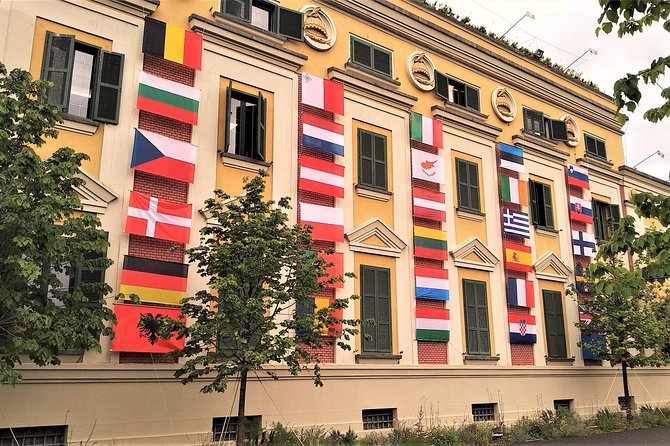
The pedestrian Murat Toptani route works as the tour’s connecting spine. It leads through a central area where historic buildings, public institutions, and newer attractions sit close together.
Along the way, you may pass the Academy of Sciences, the old National Library, the former Political Persecutor’s Building, the National Gallery of Arts, and the residence of the Albanian royal family. Tanners Bridge is also part of this historic corridor. Not every site receives a long stop, but the route gives your guide plenty to point out.
This is where the tour’s walking format pays off. You are not simply transported between monuments. The spaces between them show how Tirana has layered different eras on top of one another.
The route is pedestrian, but you should still wear comfortable shoes. The tour lasts several hours and includes outdoor walking in what may be strong sun. One booking specifically noted that the guide tried to keep the group in the shade when possible, a small detail that can matter in warmer weather.
More Walking Tours in the world:
- Marbella Old Town: Private Walking Tour with Olive Oil Tasting
★ 5.0 · 54 reviews - Puglia: Olive Oil Tasting Experience with Olive Grove Walk
★ 4.6 · 49 reviews - DISCOVER SORRENTO, food &Walking tour . Lemons-cheese&olive oil
★ 4.5 · 34 reviews - Cres: Olive Oil Walking Tour with Tastings
★ 4.9 · 24 reviews
Tirana Castle and the tasting break
Tirana Castle, known locally as Kalaja e Tiranës, is one of the city’s newer visitor areas. It sits on Toptani Pedestrian Street and combines the idea of a historic fortress with a modern food and shopping setting.
Do not expect a preserved medieval castle complex on the scale of a major European fortress. The appeal here is the setting and the way the site has been brought into contemporary city life. It gives you a chance to see how Tirana presents its past while making room for cafés, restaurants, and other modern uses.
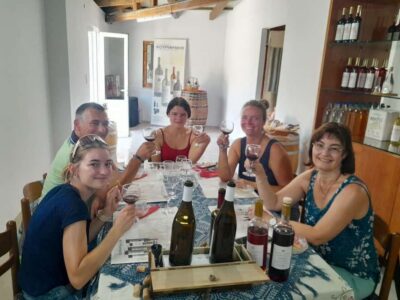
The olive oil and raki tasting is one of the tour’s most distinctive features. You sample several extra-virgin olive oils along with different rakis distilled from fruit such as blackberries and plums. The tasting has been associated with the castle stop, making it a natural pause during the walk.
Raki is not one single drink. Fruit-based versions can taste quite different from one another, so this is more interesting than simply being handed a standard shot. If you do not drink alcohol, the tasting may be less appealing, and the provided information does not promise a nonalcoholic substitute. Meals, snacks, and other drinks are not included.
The tasting adds value because it connects the city walk with something distinctly Albanian. You are not only looking at buildings. You are also getting a small introduction to local produce and hospitality.
Italian planning and Tirana’s grand boulevard
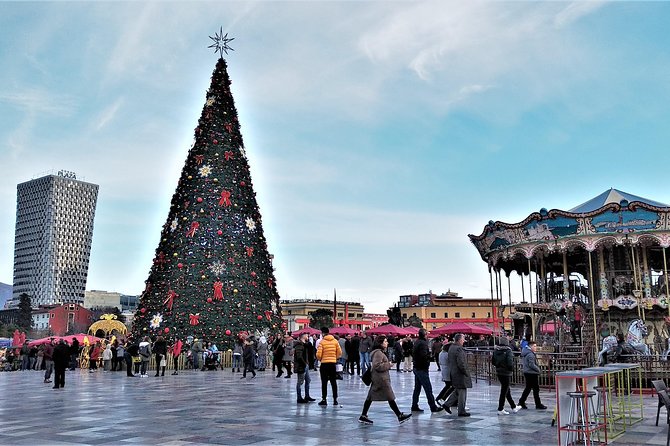
The tour also discusses the Italian architects who shaped Tirana’s central style. Brasini gave the main boulevard a grand European Renaissance character. Later, Gherardo Bosio developed its formal appearance with neoclassical buildings and a more practical civic design.
Benito Mussolini took an interest in the boulevard project and called both architects to special audiences to hear about its progress. That detail gives the architecture a more complicated meaning. The grand façades were not created in a political vacuum. They belong to a period when Fascist Italy sought influence in Albania.
This is the kind of context that can be hard to pick up from a guidebook while walking alone. You see the buildings, but the guide can explain why the boulevard looks so different from the older parts of the city.
The tour does not promise a dedicated architectural walk, so expect a clear introduction rather than a specialist study of every façade. For most first-time visitors, that is enough to make the central streets easier to read.
Blloku, from restricted quarter to social center
Blloku, also called Ish-Blloku, is one of the most revealing stops. Today it is associated with boutiques, restaurants, cafés, pubs, and nightlife. During the communist period, however, it was a restricted residential area for members of the political leadership.
Ordinary Albanians were not allowed to enter freely. The former home of communist leader Enver Hoxha remains in the area, although the walk does not promise an interior visit.
That contrast gives Blloku its importance. You can see how a sealed political district became a popular social area after the fall of communism. It is not just a place for coffee. It represents a major change in who could use the city and how public life worked.
The stop is brief, around 15 minutes, so you will not have much time for shopping or a meal during the formal tour. I would return later if you want to explore the cafés and restaurants. During the walk, focus on the explanation of the area and its changing role.
The Pyramid of Enver Hoxha
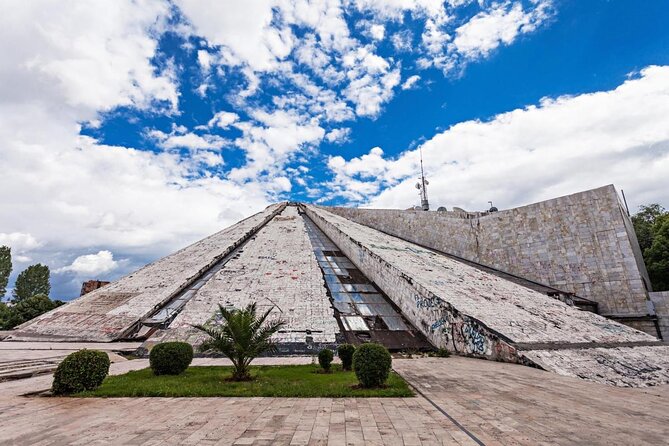
The Pyramid is one of Tirana’s most recognizable buildings. It opened in 1988 as the Enver Hoxha Museum and served as a heritage museum for the communist leader until 1991.
Its shape was designed to resemble an Egyptian pyramid, but from above it also forms a communist star with rays spreading outward. The building’s design is striking, but its political meaning is the real reason to stop here.
The Pyramid has since been renewed, and the current structure offers a different experience from its original role. The tour provides about 15 minutes, enough for your guide to explain the building’s purpose and its place in modern Tirana.
I find this stop particularly useful for visitors who want to understand Albania beyond pretty squares and cafés. The country’s communist period ended only in the early 1990s, and the city still lives with that memory. The Pyramid makes that recent past visible.
What the $22.69 price gives you
At $22.69 per person, the tour is priced as an affordable orientation walk rather than a full-day cultural program. You receive a certified professional guide and the olive oil and raki tasting. The main sights are explored from the outside, and admission fees are not listed because the stops are free.
The value is strongest if you are new to Tirana. A guide can help you understand the city’s political changes in a few hours, then point you toward places to eat or shop afterward. One account describes getting recommendations for local restaurants and shops, along with sharing a coffee during the walk. Coffee is not listed as an inclusion, so do not treat that as guaranteed.
The price is less compelling if you want extended time inside museums, a large meal, or transportation between distant parts of the city. This is a central walking tour with a tasting, not a complete city sightseeing package.
The experience is described as private for your group, while the additional information gives a maximum of 30 participants. Since those details can mean different booking arrangements, I would confirm the group setup if having a private walk is important to you.
Timing, meeting point, and practical details
The tour begins at the equestrian statue of Skanderbeg in Skanderbeg Square and ends back at the same meeting point. That makes planning easy, especially if you are staying in central Tirana.
The total duration is about 2 to 3 hours. The exact pace may depend on questions, walking speed, and the tasting. The tour is offered in English, and confirmation is provided when you book.
Most people can take part, and the meeting point is near public transportation. There is no mention of hotel pickup, so plan to reach Skanderbeg Square yourself.
Good weather is required. If poor weather causes cancellation, you are offered another date or a full refund. You can cancel for a full refund up to 24 hours before the start time. Changes or cancellations inside that 24-hour window are not accepted.
The provider’s past scheduling mistake is worth noting without making it the whole story. A date amendment was not reflected in the schedule, and the operator later offered a full refund and a free replacement tour. To avoid confusion, check the confirmed date and keep the provider’s contact information handy.
Who should book this walk
I would choose this tour if you want a clear introduction to Tirana, enjoy walking, and like history explained through ordinary city streets. It suits first-time visitors, couples, small groups, and anyone who wants a local guide before exploring alone.
It is also a good match if food and drink help you connect with a place. The tasting is modest, but olive oil and fruit raki give the tour a local flavor that a standard monument walk lacks.
You may prefer another option if you need extensive museum time, dislike alcohol, want a private tour with a guaranteed very small group, or have limited tolerance for outdoor walking. The tour includes no meal, snacks, or additional drinks.
Should you book the Tirana Walking Tour?
Book it if you want an affordable, well-focused introduction to central Tirana. The strongest elements are the guide-led explanation of Albania’s political past, the contrast between Blloku and the Pyramid, and the tasting of olive oils and fruit rakis.
The tour is most useful at the start of your stay. Afterward, you will have a better sense of where the old center ends, where the modern café district begins, and which places deserve a second look. Just confirm your date, arrive at the Skanderbeg statue on time, and wear comfortable shoes.
FAQ
Where does the tour begin?
It begins at the equestrian statue of Skanderbeg in Skanderbeg Square, Tirana.
Where does the tour end?
The activity ends back at the meeting point in Skanderbeg Square.
How long does the walking tour last?
It lasts approximately 2 to 3 hours.
What language is the tour offered in?
The tour is offered in English.
What is included in the price?
The price includes a professional certified guide and a tasting of extra-virgin olive oils and different fruit-based rakis.
Are meals, snacks, or drinks included?
No. Meals, snacks, and drinks other than the included tasting are excluded.
What sights are visited?
The route includes Skanderbeg Square, Tirana Clock Tower, Murat Toptani Street, Tirana Castle, Blloku, and the Pyramid of Enver Hoxha.
Can I cancel for a full refund?
Yes. You can cancel at least 24 hours before the experience starts for a full refund. Poor-weather cancellations offer another date or a full refund.
Just added around the world
- XXI Century Olive Oil Mill Tour★ 5.0 · 3 reviews
- Zadar, Šibenik: olive oil, wine & food tasting, Self Drive★ 4.7 · 9 reviews
- Vernazza (5 Terre): olive grove tour and oil and wine tasting★ 5.0 · 9 reviews
- Visit to an olive oil mill and oil tasting with aperitif and food and wine pairing.★ 5.0 · 2 reviews
- Athens: Greek Wine & Olive Oil Tasting at Brettos Plaka★ 4.5 · 3 reviews
- Trevi: Guided tour and tasting at Frantoio Gaudenzi★ 5.0 · 3 reviews
- Unveiled Secrets of Porto + Olive Oil Tasting★ 4.8 · 3 reviews
- Ulldecona: Guided Tour of the Millenary Olive Trees of Arión★ 5.0 · 2 reviews
Raki & Ouzo Tastings, compared.
Full-Day Cretan Wines, Olive Oil, Raki and Food Tour
Read our review →
Olive Oil, Soap, Wine, Raki – Flavorful Culinary Journey
Read our review →
Olive, Wine, & Raki on a Flavorful Culinary Journey
Read our review →
Premium Crete Olive oil tasting, Wine, Raki and Cretan food!
Read our review →
Premium Cretan Olive Oil Tasting, Wine, Raki and Local Food Tour
Read our review →
Small Group: Knossos, Olive Oil, Winery & Raki with Lunch
Read our review →
Soap, Wine, Raki, Olive Oil, Meet the local Producers Tour
Read our review →Browse the lists this tour appears in